
ethnic wear
Ethnic Wear Size Guide: How to Measure for Sarees, Kurtis & Lehengas
Why Sizing Matters for Ethnic Wear
If you have ever ordered a kurti online only to find the shoulders too tight or the length oddly short, you are not alone. Sizing in Indian ethnic wear is one of the most confusing aspects of fashion shopping in India, and it trips up even experienced buyers. Unlike western clothing, where sizes are relatively standardised across brands, Indian ethnic wear has no universal sizing system. An "L" from one brand may fit like an "M" from another, and a "Free Size" label can mean almost anything depending on the manufacturer.
The confusion exists because Indian garments are designed for a different body geometry than western clothes. A kurti prioritises bust and length over waist, since most silhouettes are meant to skim the body rather than cinch it. A lehenga fits at the waist but must account for hip flare and the weight of heavy fabric. A saree blouse, on the other hand, needs to be snug enough to support six yards of draped fabric without shifting.
Understanding your actual measurements — not just the size label you usually pick — eliminates guesswork. It reduces returns, saves the frustration of alteration trips, and ensures every outfit you buy feels comfortable from the first wear. This guide gives you everything you need: how to measure yourself accurately, size charts for every major category of ethnic wear, and practical tips for getting the fit right whether you shop online or visit us in store.
How to Take Your Measurements
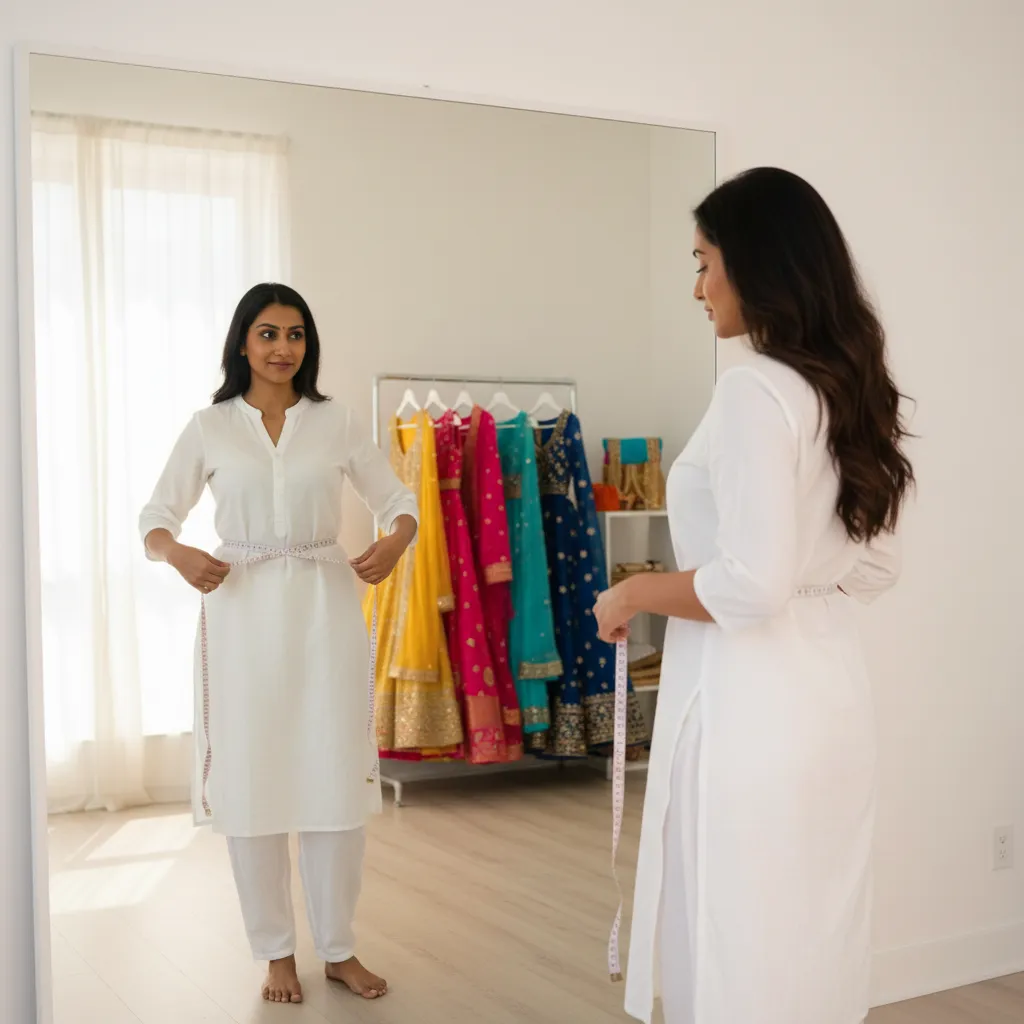
Accurate measurements are the foundation of a good fit. Before you start, gather a soft measuring tape (the flexible kind used by tailors, not a metal construction tape), a mirror, and a pen and paper to record your numbers. Wear lightweight, fitted clothing — a thin T-shirt and leggings are ideal. Avoid measuring over a padded bra or bulky fabric, as these will add false inches and throw off your results.
Bust: Wrap the tape around the fullest part of your bust, passing over the shoulder blades at the back. Keep the tape parallel to the floor — do not angle it up or down. The tape should be snug but not compressing. You should be able to slide one finger underneath comfortably. This is the single most important measurement for kurtis, blouses, and most upper-body garments.
Waist: Measure at your natural waist, which is the narrowest point of your torso — typically about two inches above your navel. Do not suck in your stomach. Stand naturally and breathe normally. This measurement is critical for lehengas, salwar suits, and fitted kurtis.
Hips: Wrap the tape around the widest part of your hips, usually about 7-9 inches below your waist. Keep your feet together and stand straight. Hip measurement matters for A-line kurtis, lehengas, and any garment that skims over the lower body.
Shoulder Width: Measure from the outer edge of one shoulder bone to the other, going straight across the back of your neck. This is important for structured garments like Anarkali suits and jackets.
Arm Length: With your arm relaxed at your side and slightly bent, measure from the shoulder point to your wrist bone. For three-quarter sleeves, measure to the midpoint of your forearm.
Torso Length: Measure from the base of your neck (where a necklace would sit) down to your natural waist. This helps determine the right kurti length and blouse proportion.
Inseam: Stand straight and measure from the inner thigh (crotch point) down to the ankle bone. This is essential for churidar, palazzo, and pant-style bottoms.
A few golden rules: always measure twice and take the average. Stand naturally — do not pose, suck in, or puff out. Ask someone to help if you cannot reach around your back comfortably. And write down every number immediately — you will forget them faster than you think.
Kurti and Kurta Size Chart
The kurti is the most versatile garment in Indian fashion, worn to offices, markets, festivals, and everything in between. Getting the right size means understanding which measurements matter most for the silhouette you are choosing.
| Size | Bust (inches) | Waist (inches) | Hip (inches) | Length (inches) | |------|--------------|----------------|--------------|-----------------| | XS | 32 | 26 | 35 | 36 | | S | 34 | 28 | 37 | 37 | | M | 36 | 30 | 39 | 38 | | L | 38 | 32 | 41 | 39 | | XL | 40 | 34 | 43 | 40 | | XXL | 42 | 36 | 45 | 41 | | 3XL | 44 | 38 | 47 | 42 |
The silhouette of your kurti changes which measurement you should prioritise. For A-line kurtis, the bust is the anchor measurement because the garment flares out naturally from the chest — even if your hips are wider than the chart suggests, the A-line cut will accommodate them. These are the most forgiving style for women who carry weight around their midsection. For straight-cut kurtis, both bust and hip matter equally because the garment falls in a column. If your bust and hips differ by more than one size bracket, go with the larger size and have the other area taken in by a tailor. For Anarkali kurtis, the bust and shoulder width are critical since the dramatic flare below the bustline means hip and waist measurements are largely irrelevant.
Kurti length is another consideration that many size charts overlook. A "regular" length typically falls at or just below the knee (38-40 inches), while "long" kurtis extend to mid-calf (44-46 inches). If you are shorter than 5'3", consider sizing down in length or choosing short kurtis (32-34 inches) that hit at mid-thigh — these pair beautifully with jeans and palazzos. For more on pairing kurtis with different bottoms, read our kurti styling guide.
Lehenga Size Chart
Lehengas are one of the most emotionally significant purchases in Indian fashion — brides spend months planning theirs, and wedding guests want to look their absolute best. Yet lehenga sizing causes more confusion than any other garment because the fit depends almost entirely on the waist and hip, while the length needs to work with your height and heels.
| Size | Waist (inches) | Hip (inches) | Length (inches) | Recommended Height | |------|----------------|--------------|-----------------|-------------------| | S | 26-28 | 36-38 | 40 | 5'0" - 5'3" | | M | 28-30 | 38-40 | 41 | 5'2" - 5'5" | | L | 30-32 | 40-42 | 42 | 5'3" - 5'6" | | XL | 32-34 | 42-44 | 43 | 5'4" - 5'7" | | XXL | 34-36 | 44-46 | 44 | 5'5" - 5'8" |
Most lehengas come with a drawstring or elastic waist that provides 2-3 inches of adjustment in either direction. This is one of the most forgiving design features in ethnic wear, and it means you do not need to agonise over a half-inch difference between your waist and the chart. If your waist sits between two sizes, choose the smaller size and let the drawstring do its work. However, hips have no such adjustment — if a lehenga is too tight across the hips, the fabric will bunch and pull when you sit or walk. Always prioritise hip fit over waist fit.
For bridal lehengas, we strongly recommend at least two in-store trial sessions. Bridal pieces carry significant weight due to heavy embroidery, zari, and embellishments, and this weight causes the lehenga to hang differently on the body than a lighter festive piece. A bridal lehenga that feels perfect in a five-minute trial can become uncomfortable after four hours of ceremonies if the waist sits too high or the length catches under your heels. Visit our Kishangarh store for bridal consultations where our team will help you get the measurements exactly right, recommend the correct heel height to match your lehenga length, and ensure the weight distribution feels comfortable across your hips. For more guidance on choosing your wedding outfit, read our bridal lehenga guide.
Saree Blouse Size Chart
The saree blouse is arguably the most measurement-sensitive garment in Indian fashion. It needs to be snug enough to anchor a six-yard saree without slipping, yet comfortable enough to wear for hours. Too loose and the saree pallu slides off your shoulder every few minutes. Too tight and you spend the day unable to raise your arms or take a full breath.
| Size | Bust (inches) | Underbust (inches) | Shoulder (inches) | Sleeve Length (inches) | |------|--------------|-------------------|-------------------|----------------------| | 32 | 32 | 28 | 13.5 | 5.5 | | 34 | 34 | 30 | 14 | 6 | | 36 | 36 | 32 | 14.5 | 6 | | 38 | 38 | 34 | 15 | 6.5 | | 40 | 40 | 36 | 15.5 | 6.5 | | 42 | 42 | 38 | 16 | 7 |
The ideal blouse has approximately 0.5 to 1 inch of ease at the bust — meaning the blouse measurement should be half an inch to one inch more than your actual bust measurement. This provides just enough room for comfort and breathing without creating visible gaps or bunching. The underbust measurement is equally important because this is where the blouse band sits, and it needs to be firm enough to hold the saree tuck in place.
Shoulder width determines how the blouse sits on your frame. If the shoulder seam falls even half an inch past your actual shoulder point, the sleeve will droop and the neckline will gape. This is the measurement that most off-the-rack blouses get wrong, which is why many women in Rajasthan still prefer custom-stitched blouses from local tailors. At Barkha Boutique, we offer blouse stitching services alongside our saree purchases — bring your measurements or let our team measure you in store, and we will deliver a blouse that fits like it was made for you, because it literally was. Readymade blouses work well if your measurements align closely with the standard chart, but for important occasions — weddings, festivals, formal events — a custom blouse makes a noticeable difference in how the entire saree looks and feels.
Salwar Suit Size Chart
Salwar suits are the everyday armour of Indian women — comfortable, modest, and endlessly versatile. But the fit requirements change dramatically depending on the bottom style you choose.
| Size | Bust (inches) | Waist (inches) | Hip (inches) | Kameez Length (inches) | Bottom Length (inches) | |------|--------------|----------------|--------------|----------------------|----------------------| | S | 34 | 28 | 37 | 38 | 38 | | M | 36 | 30 | 39 | 39 | 39 | | L | 38 | 32 | 41 | 40 | 40 | | XL | 40 | 34 | 43 | 41 | 41 | | XXL | 42 | 36 | 45 | 42 | 42 | | 3XL | 44 | 38 | 47 | 43 | 43 |
The bottom style dictates which lower-body measurements matter. Churidar bottoms are fitted from waist to ankle and gather in folds at the lower leg. They require accurate hip, thigh, knee, and ankle measurements because the fabric follows the contour of your leg. If you are between sizes, size up — a churidar that is too tight will restrict movement and create unflattering pull lines across the thighs. Patiala bottoms are voluminous with deep pleats, so they are extremely forgiving on fit. Waist measurement is the only one that truly matters since the fabric billows freely below. Patiala suits are an excellent choice for women who want maximum comfort without worrying about exact lower-body measurements. Palazzo bottoms are wide-legged and straight-falling. Waist and length are the critical measurements. The palazzo should graze the floor when you are wearing flat footwear — too short and it looks like regular trousers, too long and you trip. If you are buying a palazzo suit online, measure your inseam carefully and compare it against the brand's length specification.
Tips for Online Shopping
Buying ethnic wear online offers convenience and variety, but getting the size right requires a bit more diligence than shopping in store. Here are six tips that will save you from returns and disappointments.
Always check the brand's specific size chart. Do not assume that your size in one brand translates directly to another. An "L" at Brand A might correspond to a "10" at Brand B and an "XL" at Brand C. Every reputable online store publishes its own size chart — spend thirty seconds cross-referencing your measurements against it before adding to cart.
When you are between two sizes, size up. This is the single most useful rule for Indian ethnic wear. Indian garments are much easier to take in than let out. A kurti that is half an inch too large can be fixed with a five-minute alteration at any local tailor. A kurti that is half an inch too small is either uncomfortable or unwearable.
Account for fabric shrinkage. Cotton and cotton-blend fabrics can shrink by 3-5% after the first wash, especially in hot water. If you are buying a cotton kurti or suit, and your measurements place you at the upper end of a size range, go one size up. Synthetic fabrics like polyester and georgette do not shrink, so you can buy your exact size with confidence.
Read customer reviews for fit feedback. Real buyers often mention whether a garment runs small, large, or true to size. A pattern of reviews saying "runs small" is worth more than any size chart. Pay special attention to reviews from customers who mention their measurements — "I am 5'4" with a 36 bust and the M fit perfectly" is gold.
Buy early for weddings and special events. Give yourself at least three to four weeks of buffer before the event. This allows time for delivery, trying on, and any necessary alterations. Last-minute purchases force you into accepting imperfect fits because there is no time to exchange or alter.
Understand the exchange policy before you buy. At Barkha Boutique, we offer hassle-free exchanges because we know that online sizing is imperfect. Check the store's return and exchange window, whether they cover shipping costs for size exchanges, and whether sale items are final sale. Knowing this upfront removes the anxiety from online shopping.
Getting the Perfect Fit at Barkha Boutique
Nothing replaces the experience of trying on an outfit in person, and that is exactly what our stores are designed for. At Barkha Boutique, our team is trained to take accurate measurements, recommend the right size across different silhouettes, and suggest alterations that can transform a good fit into a perfect one.
Our Kishangarh store carries the full range of ethnic wear — kurtis, lehengas, sarees, salwar suits, and western wear — with trial rooms and measurement assistance available every day. If you are shopping for a wedding or special occasion, we recommend booking a visit so we can give you dedicated attention and help you build a complete look from head to toe. Our Makrana store offers the same collection and fitting services for customers in and around Makrana, Nagaur, and surrounding areas.
Whether you visit in store or shop from our online collection, our goal is the same: to ensure that every outfit you buy from Barkha Boutique fits comfortably, flatters your body, and makes you feel confident. If you have questions about sizing, fabric, or fit, check our FAQ page or reach out on WhatsApp — we are always happy to help you find your perfect size.
Frequently Asked Questions
How do I know if a kurti will fit me without trying it on?
Compare your bust, waist, and hip measurements against the brand's size chart. The bust measurement is usually the most important for kurtis. If your bust and waist fall in different sizes, choose the larger size.
What size should I order if I am between two sizes?
For ethnic wear, always size up. Indian ethnic garments are easier to take in than let out. A slightly loose kurti looks intentional (relaxed fit), while a tight one looks uncomfortable.
Do Indian clothing sizes differ from western sizes?
Yes. Indian sizes tend to run smaller than western (US/UK) sizes. An Indian L is often closer to a US M. Always rely on actual measurements in inches/centimetres rather than S/M/L labels.
How much does a saree blouse measurement differ from regular bust size?
A saree blouse is measured at the fullest point of the bust and is cut with less ease than a regular top. A good blouse should be snug (about 0.5-1 inch ease) to provide proper support for the saree drape.
VISIT US TODAY
Shop the Collection at Barkha Boutique
Visit our stores in Kishangarh & Makrana, Rajasthan or browse our online collection.